
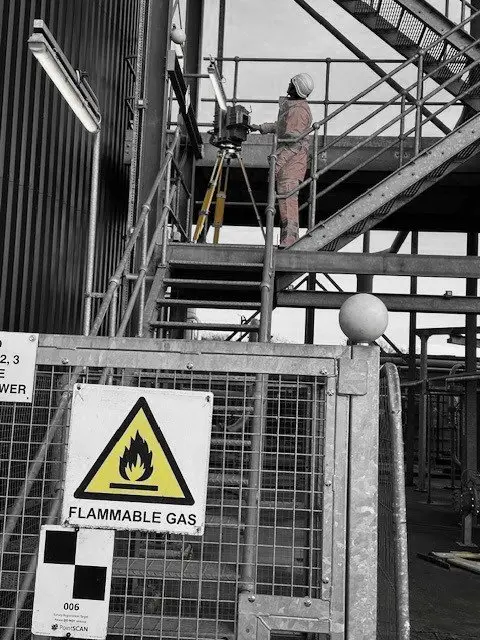
Introduction to Laser Scanning in Hazardous Environments
ATEX and Intrinsically Safe 3D Laser Scanning provides a safe and effective method for capturing accurate digital survey data within hazardous industrial environments where explosive atmospheres may be present.
Industrial infrastructure frequently requires detailed spatial information to support engineering design, plant modifications and long-term asset management. In recent years, 3D laser scanning has become one of the most effective techniques for capturing highly detailed measurements across complex facilities.
However, many industrial sites operate within environments where flammable gases or vapours may be present. Facilities such as water and wastewater treatment works, chemical processing plants, fuel storage terminals and marine infrastructure often contain areas classified under ATEX regulations due to the potential presence of explosive atmospheres.
Within these hazardous areas, the use of conventional electronic equipment can present an ignition risk. As a result, specialised survey technology and strict safety procedures are required when undertaking survey work in these environments.
This is where ATEX-certified and intrinsically safe 3D laser scanning technology becomes essential, allowing highly accurate digital surveys to be undertaken safely within hazardous industrial facilities.
What is ATEX 3D Laser Scanning?
ATEX 3D laser scanning refers to the use of intrinsically safe survey equipment that has been specifically designed and certified for operation within hazardous environments.
The ATEX directive defines the standards required for equipment operating within explosive atmospheres throughout Europe. Environments containing flammable gases or vapours are typically categorised into Zone 1 or Zone 2, depending on the likelihood of an explosive atmosphere being present.
Within these zones, equipment must be designed so that it cannot generate sparks, electrical discharge or excessive heat capable of igniting the surrounding atmosphere.
Conventional laser scanners are not certified for operation within such environments, meaning that alternative intrinsically safe technology must be used when undertaking survey work within hazardous areas.

Intrinsically Safe 3D Laser Scanning Technology
Intrinsically safe equipment is designed so that the electrical energy present within the system remains below levels capable of causing ignition. By limiting voltage, current and stored energy within electrical circuits, intrinsically safe devices can operate safely even in the presence of flammable gases.
The Z+F IMAGER® 5006EX is the only intrinsically safe terrestrial laser scanner currently designed for ATEX Zone 1 & 2 environments.
This instrument is the only terrestrial laser scanner specifically designed for operation within ATEX Zone 1 and Zone 2 environments, allowing survey engineers to safely capture detailed three-dimensional data within hazardous industrial facilities.
The scanner rapidly captures millions of measurements across the surrounding environment, generating a highly accurate point cloud dataset that digitally represents the geometry of the facility.
These datasets can then be processed to produce a wide range of engineering deliverables including:
registered point cloud datasets
accurate 2D CAD drawings
3D models and BIM outputs
digital asset records for infrastructure management
For complex industrial sites, this digital data provides a reliable foundation for design work, asset management and future modifications.
Challenges of Hazardous Area Laser Scanning
Although intrinsically safe scanning technology makes it possible to survey hazardous environments, deploying this equipment presents a number of operational challenges.
ATEX-certified scanning equipment is highly specialised and requires careful planning before it can be deployed on site. Unlike standard survey equipment, intrinsically safe scanners are typically sourced internationally and involve strict transport and documentation requirements.
In addition, the equipment is usually supplied on a fixed weekly deployment basis, meaning mobilisation costs can be significant when deployed for a single project.
Survey teams must also be trained in hazardous-area working practices to ensure that all work is carried out safely and in compliance with site procedures.
These factors mean that hazardous-area laser scanning projects require careful coordination to ensure efficient deployment.

PointSCAN's Shared ATEX Deployment Model
PointSCAN have been completing ATEX surveys for several years and the largest expense ralates to sacnner, import and exportcosts and customs duties which must be absorbed by the project cost.
However attend 2 or more sites and this cost is divided between each project reducing overhead cost by 50% and more. So to improve efficiency when deploying intrinsically safe scanning equipment, projects can be coordinated within structured survey deployment programmes.
The result is a far more efficient deployment model which enables organisations to access specialist survey technology while maintaining the same survey quality and deliverables.
This approach does not reduce the quality of the survey work undertaken. Instead, efficiencies are created through improved coordination and scheduling of specialist resources.
Industries Using ATEX 3D Laser Scanning
Intrinsically safe laser scanning is increasingly used across a range of industrial sectors where hazardous environments are present.
These may include but are not limited to:
Water & Wastewater Infrastructure
Facilities such as sludge digesters, pumping stations and treatment infrastructure often contain gas zones where intrinsically safe equipment is required.
Chemical Processing Plants
Complex processing facilities frequently require accurate digital data when planning plant modifications within hazardous areas.
Petroleum & Fuel Infrastructure
Tank farms, refineries and fuel terminals often contain large ATEX-classified areas where conventional survey equipment cannot be used.
Marine & Offshore Infrastructure
Fuel storage compartments and confined machinery spaces may also require intrinsically safe survey equipment.
Planning an ATEX Laser Survey
When planning survey work within hazardous environments, early coordination is essential. Access requirements, site safety procedures and shutdown periods must all be considered when scheduling survey activities.
By working with specialist survey teams experienced in hazardous environments, organisations can ensure that accurate digital data is captured safely and efficiently.
ATEX & Intrinsically Safe Laser Scanning
Intrinsically safe 3D laser scanning provides a reliable method for capturing detailed spatial data within environments where conventional equipment cannot safely operate.
By combining specialist equipment with experienced survey engineers, organisations can obtain the accurate digital data required to support complex infrastructure projects across hazardous industrial environments.
ATEX & Intrinsically Safe 3D Laser Scanning with PointSCAN
Intrinsically safe 3D laser scanning provides a safe and reliable method for capturing accurate spatial data within hazardous industrial environments.
By combining specialist ATEX-certified equipment with experienced survey engineers, complex facilities can be digitally captured without introducing ignition risks or disrupting operational safety procedures.
Using intrinsically safe scanning technology such as the Z+F IMAGER® 5006EX, detailed digital representations of hazardous environments can be produced to support engineering design, infrastructure upgrades, asset management and refurbishment projects.
As industrial facilities continue to evolve and modernise, the ability to capture accurate digital data within hazardous environments is becoming increasingly important for engineers, asset owners and infrastructure operators.
Specialist survey capability ensures that organisations can obtain the detailed spatial information required while maintaining full compliance with hazardous-area safety requirements.
Are you planning an ATEX Laser Survey?
If you are planning engineering work within hazardous environments and require accurate digital survey data, early coordination is recommended.
Specialist intrinsically safe laser scanning equipment and hazardous-area survey teams must often be scheduled in advance to align with site access windows and operational requirements.
For advice on planning an ATEX laser survey or to discuss upcoming infrastructure projects, please contact the PointSCAN team.
Frequently Asked Questions.
ATEX & Intrinsically Safe 3D Laser Scanning
What is ATEX 3D laser scanning?
ATEX 3D laser scanning refers to the use of intrinsically safe laser scanning equipment that has been specifically certified for operation within hazardous environments where explosive atmospheres may be present.
These environments are classified under the ATEX directive and typically include areas containing flammable gases, vapours or combustible dusts. Intrinsically safe scanning technology allows detailed three-dimensional survey data to be captured while maintaining full compliance with hazardous-area safety requirements.
What is intrinsically safe 3D laser scanning?
Intrinsically safe 3D laser scanning involves using survey equipment that is designed so that the electrical energy within the system cannot ignite explosive atmospheres.
This is achieved by limiting voltage, current and stored electrical energy within the equipment so that even under fault conditions it cannot generate sparks or heat capable of ignition. This principle allows specialist laser scanning systems to operate safely within hazardous environments.
What are ATEX Zone 1 and Zone 2 environments?
ATEX classifications define areas where explosive atmospheres may be present.
Zone 1 environments are areas where explosive gas atmospheres are likely to occur during normal operation.
Zone 2 environments are areas where explosive atmospheres are not normally present but may occur occasionally.
Equipment used within these zones must be specifically certified for hazardous-area operation.
Why can’t standard laser scanners be used in hazardous environments?
Most conventional laser scanners are not designed for operation within explosive atmospheres. Their electrical components may produce sparks, heat or electrical discharge which could ignite flammable gases or vapours.
For this reason, only intrinsically safe equipment certified for hazardous areas can be used when surveying ATEX-classified environments.
What is the Z+F IMAGER® 5006EX?
The Z+F IMAGER® 5006EX is a terrestrial laser scanner specifically designed for operation within ATEX Zone 1 and Zone 2 environments.
It is currently the only intrinsically safe laser scanner capable of capturing high-resolution point cloud data within hazardous industrial environments, allowing detailed digital surveys to be undertaken safely.
What industries require ATEX laser scanning?
ATEX laser scanning is commonly required across a number of industrial sectors where hazardous environments are present, including:
water and wastewater treatment infrastructure
chemical processing plants
petroleum and fuel storage facilities
marine and offshore assets
energy and utilities infrastructure
These facilities often contain areas where conventional survey equipment cannot safely be used.
Can ATEX laser scanning be carried out during plant operation?
In many cases, intrinsically safe laser scanning can be undertaken while facilities remain operational, provided that site safety procedures are followed.
However, survey work within hazardous environments must always be carefully planned to align with site access requirements, safety protocols and operational constraints.
How is hazardous-area laser scanning typically deployed?
Due to the specialist nature of intrinsically safe laser scanning equipment, surveys are often coordinated as part of structured deployment programmes.
By aligning multiple projects within the same deployment period, specialist equipment and survey teams can be scheduled efficiently while maintaining the same survey quality and deliverables.