
Frequently Asked Questions
Here you’ll find clear answers to the most common questions about 3D laser scanning, measured building surveys, and BIM deliverables. Whether you’re new to laser scanning or an experienced project manager, this page explains what to expect from a PointSCAN survey.


Frequently Asked Questions
What is 3D laser scanning?
3D laser scanning is a non-contact survey method that captures millions of measurement points to create an accurate digital model of any structure, space, or site. The resulting point cloud forms the basis for CAD drawings, 3D models, and BIM deliverables used by architects, engineers, and contractors.
How long does a scan take?
3D laser scanning can reduce on-site survey times by up to 80% when compared to traditional techniques. Typically individual scans can take between 50 sec – 8 mins per scan dependant upon the level of detail, location and distances being surveyed. As our team progress around your site they can acquire as many as 200 scans per day. A site may require a few to several hundred scans.
What are the benefits of 3D laser scanning?
Laser scanning provides rapid, high-accuracy data capture with minimal disruption on site. It eliminates guesswork, reduces return visits, and creates a permanent digital record for future reference. The precision data supports design validation, clash detection, and project coordination.
What industries can benefit from 3D laser surveys?
Commonly industries such as engineering, architecture, manufacturing, oil and gas, mining, and construction all make use of 3D laser surveys, but any project requiring accrate measurement data will find benefits in using the technology
How much does a measured building survey cost?
When compared to traditional survey techniques, 3D laser surveys offer excellent efficiency. As well as reducing survey times, the improved data can be interpreted resulting in a faster more comprehensive design. The long-term benefits of acquiring 3D laser surveys can be recognised throughout the project with savings still being made long after the project handover. PointSCAN‘s measured building surveys start from as little as £650.
How can 3D laser surveys improve efficiency in manufacturing?
By providing accurate measurements and digital models, 3D laser surveys can help manufacturers optimise their production lines, reduce waste, and enhance quality control.
How Do 3D Laser Surveys Improve Accuracy Across Your Project?
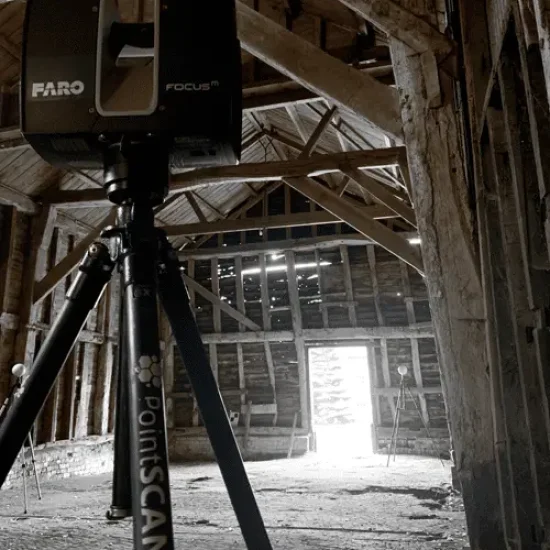
3D laser surveys give project teams a fully verified picture of what exists on site — long before design, fabrication, or installation begins. Even if your project was originally built from a design model, minor on-site changes, undocumented adjustments, and construction tolerances can all create discrepancies.
A high-accuracy as-built survey captures the true condition of the environment, helping you avoid costly clashes, delays, and rework. From digital twins and BIM models to 2D drawings and clash detection workflows, verified point cloud data provides the confidence that your project is being built on solid information.
What types of projects can be scanned?
PointSCAN’s laser scanning services cover all sectors — including commercial buildings, industrial plants, infrastructure, heritage assets, and confined spaces. Each survey is tailored to the site environment, access constraints, and required deliverables.
Can 3D laser surveys improve safety in construction?
Yes. 3D laser surveys significantly improve safety in construction by reducing the need for physical measurement in hazardous or restricted areas. Scanning allows accurate data capture from a safe distance, minimising the need for and in many cases, eliminating manual access to heights, confined spaces, or active work zones. The resulting point cloud provides precise, real-world measurements for planning, design, and verification—minimising risk, rework, and on-site exposure for survey and construction teams.
What deliverables do you provide?
We deliver registered point clouds, 2D CAD drawings, and 3D models in formats compatible with AutoCAD, Revit, and other industry software. Deliverables can include plans, elevations, sections, or full BIM-ready models depending on project requirements.
What is a point cloud & what can i do with it?
A point cloud is a 3D dataset made up of millions of measured points captured by a laser scanner. These points can be viewed visually as a realistic 3D object, showing the true shape of a site or structure. Point clouds are used to create CAD drawingss, BIM models, and dimensional checks. Point clouds help designers visualise, measure, and plan projects with precision and efficiency.
Can PointSCAN's 3D scanning services be used for large-scale projects?
Yes, our services can be used for both small and large-scale projects, and can capture detailed data of objects and environments of any size.
Can you scan through objects?
Sadly no. 3D laser scans provide surface measurement data only. This is why multiple scans are taken build up 3D images. However, the general rule of thumb is “if you can see it we can scan it”.
Due to refraction, laser scanners are not able to scan through water and it is not best practice to try to scan through windows as scan data can be destorted and give inferior measurements.

Why Are 3D Laser Surveys Essential for Infrastructure and Highway Projects?
Safely survey highways and infrastructure without traffic closures
Capture full 3D geometry for design, modelling, and clash detection
Minimise site visits through complete digital datasets
Support BIM, digital twins, and long-term asset management
Improve accuracy for road alignments, bridge assessments, and inspections
Reduce project risk by detecting errors early
How much does a 3D laser survey cost?
The cost of a 3D laser survey depends on several factors — including the size, complexity, location, and access of the site, as well as the level of detail and deliverables required. Smaller surveys may start from £450.00, while larger or multi-site projects can range into several thousand. PointSCAN provides clear, fixed quotations tailored to each project’s specific requirements.
Is 3D laser scanning safe?
Yes — 3D laser scanning is completely safe. The equipment uses Class 1 eye-safe laser technology, meaning the light emitted is no stronger than that from everyday electronic devices. Surveys are contact-free and non-destructive, so no surfaces are touched or damaged. This makes laser scanning ideal for use in occupied buildings, heritage sites, and sensitive environments.
Can I use point clouds in my CAD software?
Yes — most modern CAD and BIM software can import and work directly with point clouds. Formats such as E57, RCP, RCS, and LAS are widely supported in programs like AutoCAD, Revit, MicroStation, Navisworks, and SolidWorks. This allows you to view, measure, model, and design accurately using real-world spatial data captured from the laser scan.
PLEASE NOTE: Point clouds can generate large file sizes and may affect your computers performance

How Can 3D Laser Surveys Improve Safety and Accuracy in Hazardous or Complex Environments?
Sites affected by fire damage, demolition, structural failure, or heavy debris present significant risks — both to personnel and to traditional surveying methods. 3D laser scanning provides a safe, non-contact solution, capturing the full geometry of unstable environments without putting teams in harm’s way.
In a single visit, laser scanning records millions of precise measurements to create an exact digital representation of the site. This allows engineers, insurers, and reconstruction teams to assess damage, plan works, and make decisions remotely with full confidence in the accuracy of the data.
From structural analysis and material quantification to rebuilding and reinstatement planning, detailed as-built information helps reduce risk, eliminate guesswork, and accelerate project timelines — all while keeping people out of dangerous areas.
Can you work in confined spaces?
Yes — PointSCAN’s surveyors are fully trained and certified for confined space entry and working in hazardous environments. Our teams operate in accordance with HSE regulations and use ATEX-certified equipment specifically designed for explosive or high-risk atmospheres. By combining remote scanning techniques with safety-approved procedures, we can safely capture accurate 3D data within tunnels, chambers, tanks, and other restricted spaces. This ensures compliant, efficient, and high-quality survey results even in the most demanding conditions.
What are as-built or verification drawings?
An as-built or verification drawing is a technical record that shows how a structure or installation actually exists on site — rather than how it was originally designed. Created from 3D laser scan data, these drawings verify dimensions, alignments, and positions of structural or mechanical elements. They’re essential for quality assurance, progress tracking, and confirming that construction has been completed to design specifications.
How accurate are measurements captured with a 3D laser scanner?
PointSCAN’s 3D laser scanners capture measurements with exceptional accuracy — typically within ±1 mm, depending on the equipment used and site conditions. Each scan records millions of data points to create a highly detailed and verifiable 3D representation of the environment. This level of precision makes laser scanning ideal for engineering, construction, and heritage documentation where exact measurement is critical.
Can You Scan People with a laser scanner?
3D laser scanners are designed for static environments and objects, so they can’t accurately capture people — natural movement and breathing create distorted or incomplete data. For safety and privacy, individuals are always kept out of the scanning area.
If you need a 3D model of a person, this is typically done using photogrammetry, which captures multiple photographs from different angles and reconstructs them into an accurate 3D model.
What is a topographical survey?
A topographical survey is a detailed measurement of the natural and built features of a site — including ground levels, boundaries, buildings, roads, and vegetation. Using 3D laser scanning and GNSS technology, PointSCAN captures precise elevation data to create accurate digital terrain models (DTMs) and contour maps. This information provides architects, engineers, and planners with an essential base for design, drainage analysis, and development planning.
Who can benefit from 3d laser scanning services?
3D laser surveys prove to be beneficial to a wide range of industry professionals including architects, engineers and project managers. However, they can also be beneficial for individuals needing accurate measurement data for personal projects like 2D floor plans and elevations of a property.
Perhaps one of these pages may help?


Something Else On Your Mind?
Have a question regarding your next project — whether it’s industrial, commercial or residential.
Provide a few project details below and one of our team will get back to you as soon as they can.
Alternatively give us a call on 01767 661400